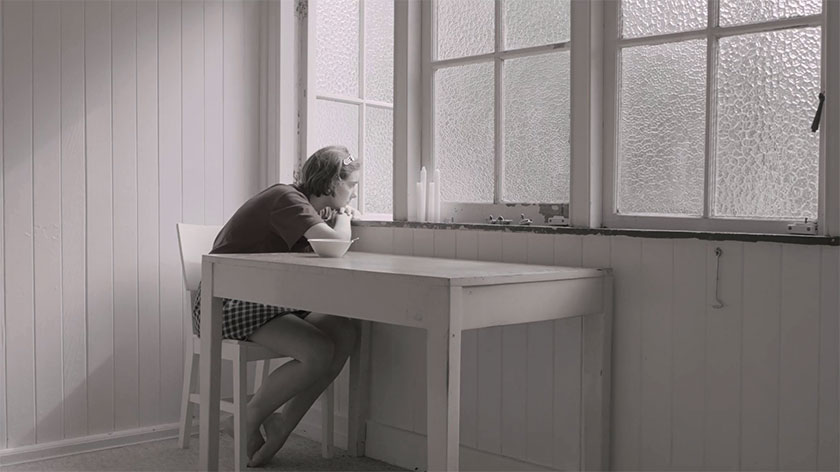
The shadow of minimalist filmmaker Chantal
Akerman echoes heavily in Grace, Who
Waits Alone, the feature directing debut of Georgia Temple – 23 at the time of making
the film.
We’re introduced to sole character Grace as she
lies on her bed, waiting in her apartment. She rarely leaves the house, and has
no conversations with other people. She is employed at a supermarket, where
time drifts by from day to night, almost by accident.
Brisbane born Temple presents her creation – a breathless character who for large swathes of the piece lies on her bed, in anticipation. The Queensland native acts in the film, as her Belgian progenitor did in her own work many times.
Her activities are mostly confined to waiting,
working, solo acts of housekeeping, and patching up a mysterious wound that
keeps re-opening in her stomach.
Grace is waiting for an unseen lover she keeps
telling us about, describing. The film has no linear dialogue. Minimally, like
the spoonfuls of sugar Akerman eats out of a paper bag in her seminal B&W Je Tu Il Elle (1974), this work by
Griffith
Film
School
Alumni
Temple
seems gently awash with small touches.
Grace certainly
mirrors the tempo of Je Tu Il Elle – the La Captive (2000) helmer’s work set in one
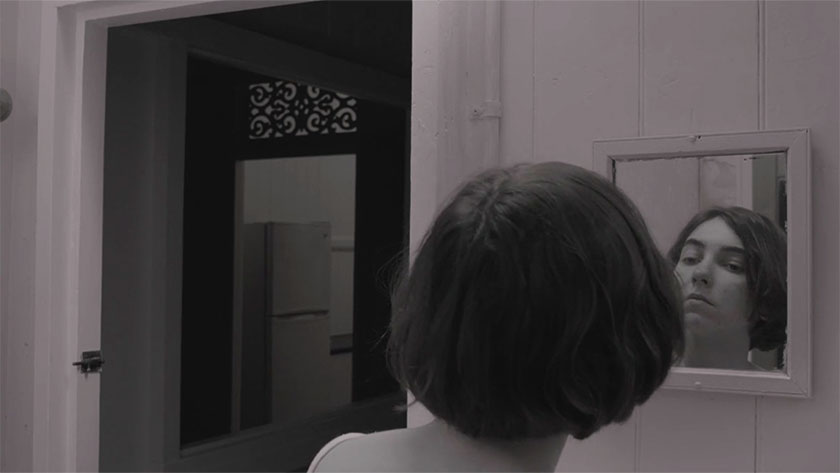
apartment for much of its implosive 1½ hour runtime. The intimacy of Grace
putting eyeliner, make-up on, juxtaposed against endless wides of her faced
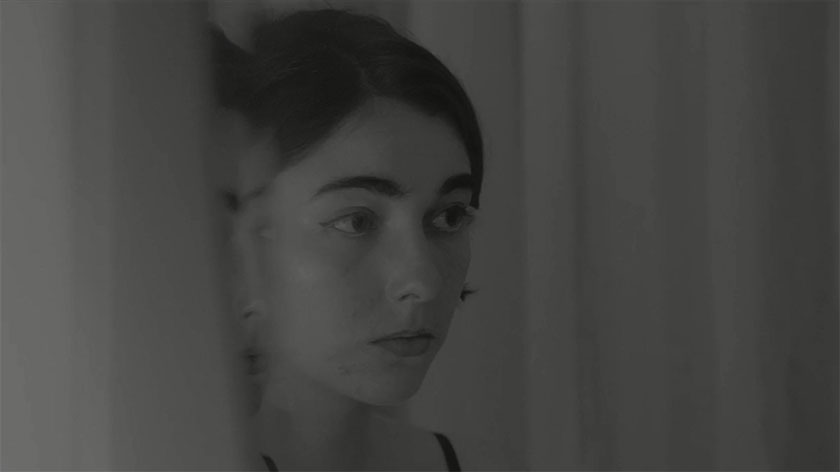
away. The full nakedness of the protagonist’s face largely not being exposed in
a close up until two thirds of the way through the film. The voiceover. The
fact that the main protagonist‘s face is mainly withheld. The use of that device
as a dramatic development – instead of a plot development or a conventional
scene. The fact there is no plot. The jaggedness. Our hero eating cake – rather
than sugar.
A line could be drawn through Grace and the varying filmography of Akerman – which often focused on isolated characters in claustrophobic settings or situations – frequently set in one room.
From her 1972 short film La Chambre, which drew on structuralist works by avant-gardists Yvonne Rainer, Jonas Mekas, Andy Warhol. A work which played with time and space, as well as repetition – a continual movement around an apartment, where Akerman, also acting in the film, lay in bed looking to camera.
Or the landmark Je Tu Il Elle, her monochrome piece following the travails of an isolated girl exiting her apartment. 1975 essential Jeanne Dielman, 23 quai du Commerce, 1080 Bruxelles was confined to the setting of a single, small apartment. Toute une nuit (1982) explored the loneliness of a group of disparate lovers over one Brussels night. To Nuit et jour (1991), Akerman’s Parisian voice-over romance following two lovers attached to themselves; who don’t have any outside relationships; nor leave their apartment – except for work.
Many of these works had voiceover, minimal
dialogue, little plot – hallmarks of this ‘slow cinema’ Akerman reworked –
which could be traced all the way to the films of Robert Bresson, Carl Theodor
Dreyer. Parallels of this glacial, wordless, visual style could even be found
in a film by, say, Jacques Tati. Up until Jeanne Dielman, Akerman often
pulled acting and directing duties.
Like with Je
Tu Il Elle and its staunch
stillness, sound design is crucial. A simple supermarket trolley
heard becomes deafening, quaking – the expectancy of a potential linear action
or plot development – a word spoken – that never comes. The tropes the audience
is used to. The fact the trolley is heard and not seen propels tension even
further. The anticipation plays on what might be, not what is.
This documentation of the smallest details runs
throughout the film. Grace applies eyeliner to her face. Grace finds a leakage
of liquid under her sheets. Pillows rustle. The summer breeze bellows. After 20
minutes of silence, quiet sequences of no narrative or physical movement – a
camera shutter goes off on Grace’s laptop. Like a gun. These ruptures are the
most volcanic moments of the film. The instances are like piercing a balloon of
pent up tension. The release is ample.
In part, we’re expecting something to happen.
Someone to walk in. A conversation. A payoff. But it doesn’t. It’s the
subversion of this trope the film is rooted in. Every mundane action or reaction
feels like a volcano. And this only heightens the build.
Adding to the isolation and claustrophobia of her
titular character, Grace interacts with and sees no other major characters on
screen. An extra in the film strolling in is a genuine surprise. The film could
almost be a genre exercise, for all the tension it saves up. Grace’s bleeding only
adds to this. But this isn’t a genre film.
Rhythm is another prominent element to the
film’s jaggedness. Long wides and extensive takes are contrasted against a quick
close-up. An element that emphasizes rhythm in
Temple’s film – repetition. Grace holds the
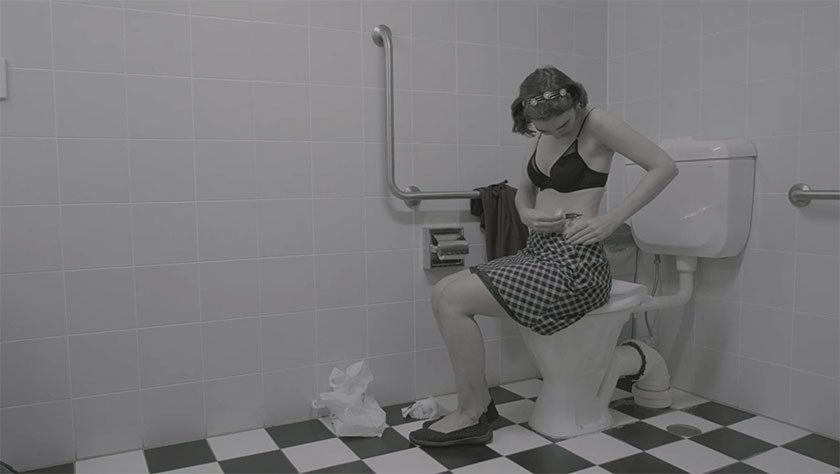
same routine. Shots run multiple minutes. She repeatedly patches up and
re-patches a wound in her stomach. Again and again. She talks of a metaphorical
wound left by an unknown lover. The actual wound keeps bleeding. She keeps
cleaning it up. She uses the public toilet. It’s the same schedule. And the
mundanity of her endless routine only adds to the entrapment of Grace’s life,
and the film; in the mould of, say, Resnais’s L'année dernière à Marienbad (1961) – extending time by repeating the same shots.
Why is Grace in this lull? What is Grace’s
wound from? Did she cut herself? Perhaps, a reminder that the character is
mortal, human – outside of her existence.
What’s the answer?
Grace waits alone.

Grace, Who Waits Alone screened in Melbourne on Wednesday, November 14, 2018.
See here for details.
Anthony Frajman is a film critic, reviewer, cinephile and filmmaker based in Melbourne, Australia. |